Why Opening Drainage and Lymph Pathways Comes Before Almost Everything Else
When people think about healing, they usually think about what to add.
Supplements.
Detox protocols.
Elimination diets.
The “right” lab.
The next thing that might finally move the needle.
But in functional and foundational medicine, healing doesn’t start with adding more.
It starts with making sure the body can safely process what it already has.
That’s where drainage, lymphatic flow, and sleep come in.
They aren’t advanced steps.
They’re the ground floor.
The Body Is Always Detoxing. The Question Is Whether It Can Keep Up.
Your body is beautifully designed to detox itself every single day.
The liver processes waste.
The gut moves it out.
The kidneys filter it.
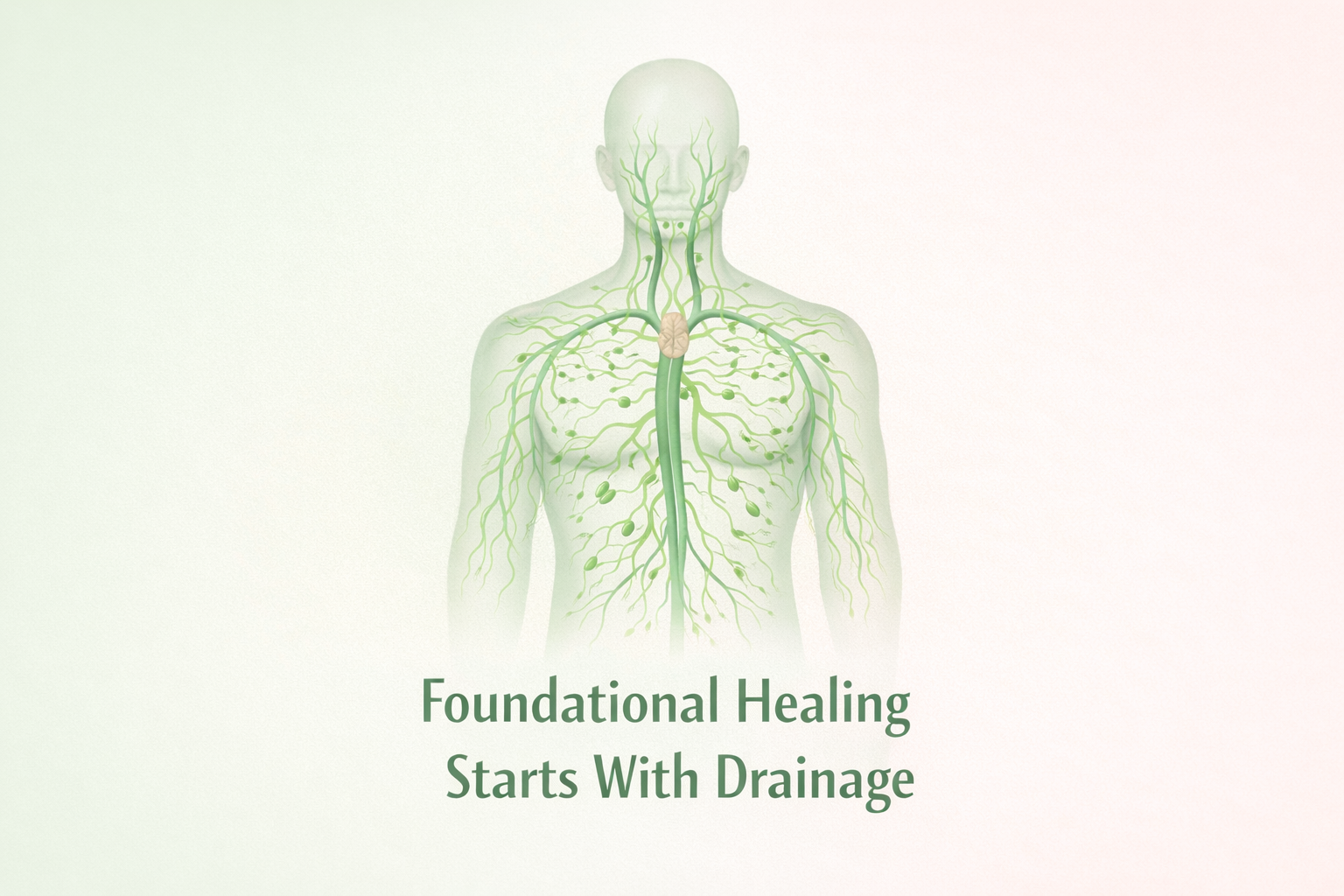
The lymphatic system carries cellular debris, inflammation, and immune byproducts away from tissues.
But here’s the part that’s often missed:
Detox is not a switch you turn on. It’s a flow.
If drainage pathways are congested or sluggish, adding more “detox support” can actually make people feel worse. Headaches. Fatigue. Skin flares. Hormone symptoms. A sense that “something isn’t right.”
It’s not because the body is broken.
It’s because we’re asking it to do more before it has clear exits.
The Lymphatic System: The Missing Link in Healing
Unlike your heart or lungs, the lymphatic system doesn’t have a pump.
It relies on:
Movement
Breath
Muscle contraction
Gravity
Hydration
Nervous system safety
Modern life works against almost all of those.
We sit.
We brace.
We breathe shallowly.
We live in a constant state of low-grade stress.
Over time, lymph becomes stagnant. Waste lingers in tissues. Inflammation has nowhere to go. The immune system stays activated longer than it should.
This can show up as:
Chronic fatigue
Brain fog
Hormone imbalance
Puffiness or swelling
Pain that “moves around”
Sensitivity to supplements or foods
Getting worse before getting better when trying new protocols
Opening lymph pathways is not about forcing detox.
It’s about restoring movement and flow so the body can do what it already knows how to do.
Sleep Is Not Optional Repair Time
If drainage is the exit ramp, sleep is the overnight clean-up crew.
Deep sleep is when:
The brain’s glymphatic system clears metabolic waste
Hormones are recalibrated
Tissues repair
Immune signaling resets
Stress chemistry quiets down
You can eat perfectly and take the “right” supplements, but if sleep is disrupted, healing will always be uphill.
This is why foundational medicine places sleep alongside drainage, not after everything else is optimized.
We don’t earn rest by being productive.
We heal because we rest.
Why Foundational Medicine Starts Here
Foundational medicine asks a different question than conventional care or even advanced functional protocols.
Instead of “What diagnosis or supplement is missing?” it asks:
“Is the body safe, supported, and resourced enough to heal?”
That means starting with:
Nervous system regulation
Circadian rhythm support
Gentle daily movement
Breath
Hydration
Bowel regularity
Sleep quality
Lymphatic flow
These are not “basic” because they are unimportant.
They are basic because everything else builds on them.
Gentle Ways to Support Drainage and Sleep
This does not require extreme protocols or expensive tools.
Small, consistent practices matter more than intensity.
Walking, especially outdoors
Deep, slow breathing that expands the ribs and belly
Light rebounding or gentle bouncing
Dry brushing if tolerated
Stretching and mobility
Hydration with minerals
Supporting regular bowel movements
Morning light exposure
Reducing light and stimulation at night
These may not feel exciting.
But they are powerful.
Healing Is Not About Doing More. It’s About Removing the Bottlenecks.
When drainage is open and sleep is supported, the body becomes more responsive.
Supplements work better.
Food becomes more nourishing.
Hormones stabilize more easily.
Inflammation resolves instead of lingering.
This is the work of foundational medicine.
Not forcing change but creating the conditions where change becomes possible.
If you’ve tried everything and still feel stuck, it may not be that you need something new.
You may need to start further upstream.
How I Found My Way to Nurse Coaching
There are certain moments that divide your life into a clear before and after.
For me, one of those moments came during the birth of my third child. I was at home, surrounded by calm and support, finally trusting my body in a way I never had before. That birth changed how I understood health, safety, and healing, not only for myself but for the people I cared for as a nurse.
But that moment didn’t appear out of nowhere. The path to it had been forming for years.
The Art of Walking Beside
Back in 2020, I left emergency and PACU nursing and began working in hospice and palliative care. The difference between those two worlds was striking.
In acute care, everything moved fast. Care was task-based and protocol-driven, often things being done to patients in the name of keeping up. It wasn’t that people didn’t care; they did. But the system didn’t make much room for pause, presence, or partnership.
Hospice was the opposite. It was slower, quieter, more intentional. For the first time, I saw what it looked like when care truly centered around the person — their values, their goals, their quality of life. The focus shifted from control to connection, from fixing to being with.
It was there that I began to understand the art of walking beside. It’s supporting rather than directing, listening rather than fixing. That change in perspective planted a seed I couldn’t ignore.
A Turning Point in My Own Healing
Motherhood magnified everything I believed about the body’s wisdom and the limits of conventional care.
After two traumatic hospital births that left me with physical and emotional complications, I went into my third pregnancy determined to do things differently. Even when I waited until the very end to go in for my second birth, the moment I stepped into the hospital, the process was taken over. My voice, my instincts, my sense of agency all seemed to dissolve in that environment.
My home birth was entirely different.
It felt peaceful and empowering. I was supported rather than managed. My body led the way. And while birth is always intense, what surprised me most was what came after. I recovered quickly, with almost no pain or complications postpartum. For the first time, I felt truly in charge of my own care, and that sense of safety changed me.
It wasn’t just a positive birth story. It was a moment of deep remembering that healing happens when we feel seen, heard, and in control of our experience.
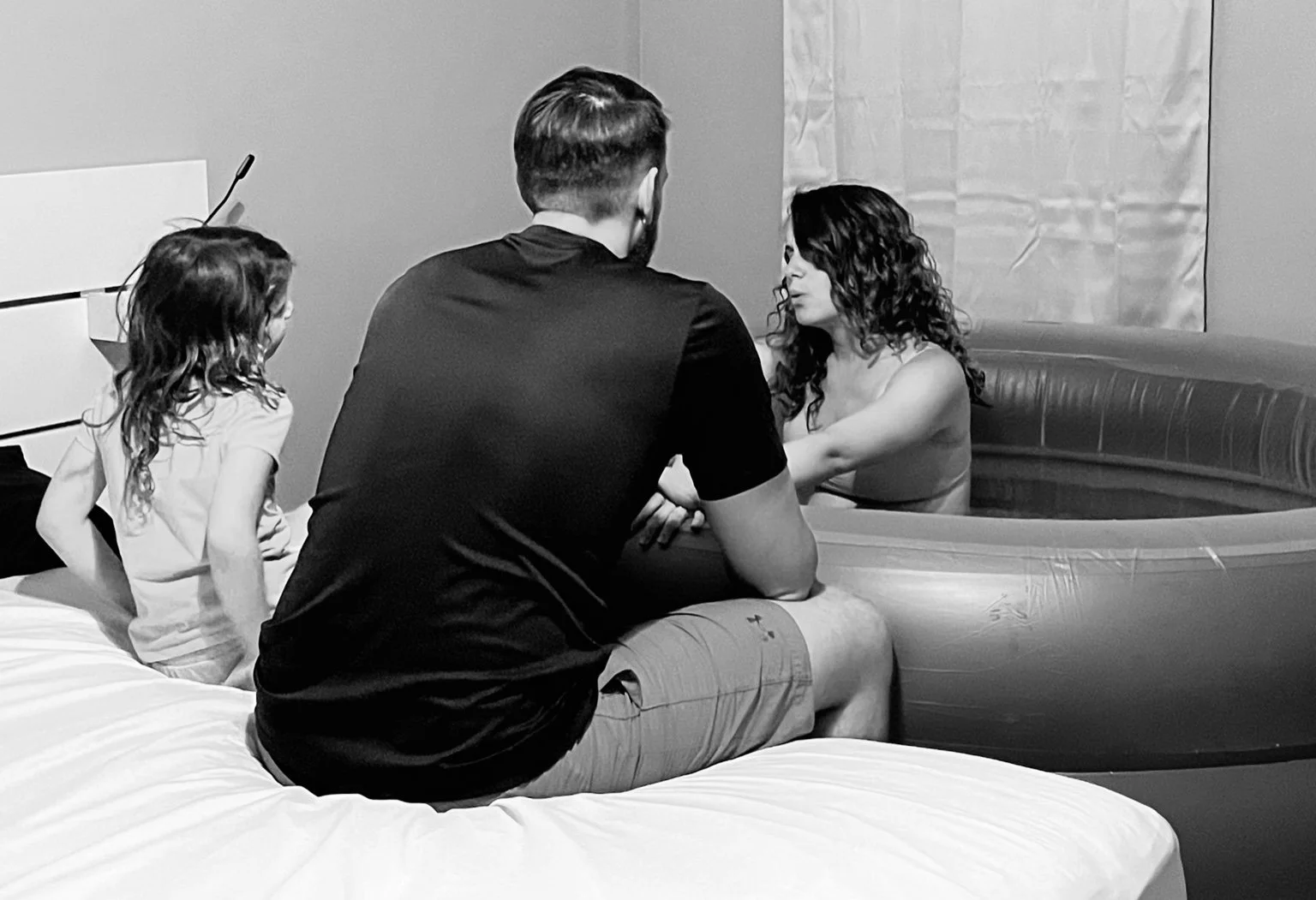
This moment was captured during my home birth, a reminder of what safety and trust can feel like when care honors the whole person.
Connecting the Dots
Those experiences, hospice and home birth, mirrored each other in ways I didn’t expect.
Both taught me that true healing doesn’t come from a procedure or a pill. It comes from being witnessed, supported, and trusted. It made me wonder: what if care like that weren’t confined to life’s bookends, but part of the everyday journey?
That question led me to explore functional medicine for nurses. I signed up for a three-month course expecting to learn about labs, supplements, and protocols. What I actually discovered was something much deeper: that functional medicine, at its core, is simply good nursing. It is holistic, individualized, and deeply personal.
The Bridge to Coaching
After that, I enrolled in a six-month Nurse Coach training program, and it felt like everything I had learned up to that point suddenly clicked into place.
This training wasn’t about disease states or lab markers. It was about listening, holding space, and helping people uncover the patterns, beliefs, and stressors that shape their health from the inside out.
It gave me the tools to deliver care that is not only informed by science but rooted in human connection. In coaching, we talk about everything from nutrition and sleep to relationships, purpose, and self-trust, because it is all connected.
Coming Full Circle
Now, when I think about what brought me here, I see a thread that runs through it all: the desire to help people feel whole.
Whether it is a client learning to balance blood sugar and feel more energized in their body, or someone finding the courage to realign their career and life with what truly matters, nurse coaching provides the space for transformation.
It is where science meets humanity. It is the kind of care I wish everyone could experience, not only in life’s beginnings and endings, but throughout the journey.
Through Bramble Wellness, that is the work I get to do now.
Because when we look at the person, not just the problem, healing becomes possible.
Carry Today: A Mindfulness Reflection on Stress, Stillness, and Letting Go of Tomorrow
At Bramble Wellness, I often remind others how stress quietly weaves its way into our lives and our health. Heading into the weekend, I made it a point to take my own advice. By beginning my day with presence instead of distraction, I found myself grounded in a way I hadn’t expected.
A Quiet Morning of Presence
This morning I rose quietly out of bed and crept down the stairs. I brewed a fresh pot of coffee and slipped out the front door to sit with the sunrise. I somewhat unconsciously began to notice the world around me—the cool concrete beneath me, the air subtly crisp and inviting.
Above, the tiniest sliver of a crescent moon reflected the promise of a new day. Three stars pin-pricked a pink sky giving way to shades of blue. I watched a plane glide across this scene, painting a trail that slowly faded as it carried its passengers on their journey.
When Awareness Awakens
My focus shifted to the earth below—the deep green grass, the smooth dark pavement of the driveway, a flock of robins—one gazing curiously at the woman on the stoop as I gazed back.
This calm state of awareness was abruptly interrupted by the cry of a toddler. I took a deep breath and quietly made my way back into the house to comfort her. I paused at the bottom of the stairs as her cries subsided and she settled back to sleep, feeling a deep sense of gratitude as I pivoted to our book room with my now cooling cup of coffee.
Words to Ground the Mind
I scanned the shelves for my Bible. Not finding it, I reached for a smaller version gifted to one of my children and sat on the floor while my daughter’s cat nuzzled in for attention.
These words found me:
“Therefore do not worry about tomorrow, for tomorrow will worry about its own things. Sufficient for the day is its own trouble.”
I paused—rereading the words over and over as I accepted their truth.
The Freedom in Letting Go
Whether you take these words as Scripture or simply timeless wisdom, there’s a gentle freedom in that verse. It doesn’t deny that life can be hard. It simply reminds us that the weight of tomorrow doesn’t belong to today.
This morning was not the norm for me. So often I step out of bed already carrying the heaviness of the days ahead, as I know so many of us do. But today I was reminded when we return to the now, something softens. The breath in our lungs becomes enough. The quiet sip of coffee becomes sacred. The sounds of nature, the feel of sunlight on our skin—suddenly, the ordinary moments steady us.
Mindfulness in Everyday Life
Mindfulness isn’t about ignoring what’s coming. It’s about tending to this moment with enough love and presence that tomorrow has space to unfold without crushing us.
So, if your mind starts racing forward—pause. Notice the world around you. Feel your feet on the ground. Take three slow, deep breaths and remind yourself:
I only need to carry today.
And when you do, you may just find that peace isn’t waiting somewhere ahead—it’s been here all along.